Showing posts with label British. Show all posts

Wednesday, 16 September 2020

Anyone for Edmund? by Simon Edge

Chez Maximka, St Edmund

I have been reflecting more on memory and its limits. I am relieved to find that there are many events in my own deepest history that I can bring to mind, so my recall is not quite as rotten and decayed as I had feared. Almost all of them, though, happened after my death.

Anyone for Edmund? by Simon Edge is a magnificent blend of political satire, magic realism and historical fiction.

The above mentioned genre attribution might not be technically correct, though as Wikipedia helpfully states that magic (or magical) realism presents a realistic view of modern world with added magical elements, I'll go with this definition. It's precisely the case when supernatural phenomena is presented in otherwise real-world or mundane setting.

The book opens with an archaeological dig nearby the ruins of Bury St Edmund's Abbey, where the monks have hidden the sacred remains of St Edmund during the Dissolution of monasteries.
Hannah is one of the community volunteers, who happens to be there, when the skull is found.

Hannah's cousin Mark is a special adviser to the "sainted" Marina Spencer. After a career at the BBC, producing programmes for the World Service, he is supposed to have his dream job with Marina.
Power-hungry Marina is a pushy bully of a boss, who has a great talent for looking approachable and friendly on TV.
Her charisma doesn't extent to her aides whom she treats as minions of no significance. "Marina Spencer was the most neurotic person he had ever met. Her anxiety focused primarily on her media appearances, which was unfortunate, since she was the government's star media performer".

All her staff are hostages to her moods.
"She would demand them at all hours of the day and most hours of the night, since she was also an insomniac and expected her staff to be the same".
Mark dreads going to the office, where he's subjected to Marina's relentless criticism and his colleagues' competitiveness.
She never gives thanks for all the hard work her staff are doing. "Expecting gratitude from Marina was like expecting not to be squeezed to death by a boa constrictor: it was an unreasonable hope that went against nature".

It so happens that Hannah shares the news of the big discovery at the dig with Mark's mother, who in her turn can't wait to spill the news to her son, "It's a very exciting development. It'll be all over the news, when they announce it. They haven't done it yet, and I thought you'd like a … what's that horrible expression?" "A heads-up?" She thinks it to be the news of great importance, since St Edmund was England's patron saint until we got St George.

Marina needs new eye-catching ideas for her talk in the cabinet. Cornered, Mark comes up with a suggestion of a new patron saint for the whole of the UK, "Bringing all four nations together, after the trauma of the past few years"
"As ideas went, it was not so much half-baked as still in the mixing bowl before he had turned the oven on".
Once he suggests it, he has to build the case as to why St Edmund could be seen as a unifying figure, "He added a silent prayer to St Wikipedia that he could find some adequate connection".
The following spin is a matter of creative genius of Mark, his imagination and resourcefulness.

Without giving any spoilers, the credentials Mark builds for Marina's ambitious campaign - manipulating history data - are brilliant.
Simon Edge is one of the best wits in the British political satire.

Every scene with Marina is pure political farce. She is a ruthless tyrant with an over-inflated ego. I loved the episode at St Edmund's Chapel, where she arrives wearing colours matching St Edmund's flags. She nearly causes a scene, when she realises that she is supposed to sit "in the blasted gods".
But when another, less prominent MP, makes a dig at Marina for sitting in the gallery, she responds, "I'm simply here to witness St Edmund's return to his proper place, Wendy. That's all that matters," said Marina, but the look that went with her words could have refrozen the polar ice cap."

As Mark's lies spin out of control, we are wondering if they are going to be exposed. He's not a contemptible, cynical political hack, in fact you'll most likely feel sympathy for him, and hope the whole brouhaha would end in his favour.

The narrative flits back and forth from Mark to Hannah to St Edmund, and that's where the narrative becomes supernatural. The Royal Saint is reliving his own life, before and after death, his miracles and legacy. Having seen Marina kneeling in front of his shrine, he takes her under his wing and wants to reward her for the seeming devotion, with the most drastic consequences for her opponents.

All Edge's books are an outstanding character study. The author is sympathetic to his hapless protagonist.
Marina is the perfect villainess whom you'll love to hate.

Edge is a skilful storyteller who reimagines the past and the present. The plot is intelligent, intricate and will keep you gripped.

After I finished reading the book, I visited the library to see if I can find anything on the British saints. There is a small extract on St Edmund in Richard James' England's Forgotten Past (2010 edition).

Chez Maximka

I also spotted Warriors of the Viking World by Ben Hubbard in The Works (at £3 at the moment), where I found this illustration.

Chez Maximka, books about English saints

Many thanks to Simon Edge and Lightning Books for my copy of the book!

modern political satire, Chez Maximka

Tuesday, 18 June 2019

Victoria to Vikings The Circle of Blood by Trisha Hughes #BlogTour

best historical non-fiction, books about Queen Victoria

In the foreword to Victoria to Vikings: The Circle of Blood Trisha Hughes writes: "Interest in the British Monarchy has ebbed and flowed over the centuries depending on the reigning monarch and the controversy surrounding said monarch... My tale is a conglomerate of accumulated facts together with my imagination, backed up by plausibility in the quicksand of history."

Victoria to Vikings - The Circle of Blood by Trisha Hughes
Synopsis:
At the heart of our present are the stories of our past. In ages gone by, many monarchs died while they were still young. There were battles and diseases and many were simply overthrown. But the days of regal engagement in hand-to-hand combat are over and the line of succession has a good ageing prospect these days.
One of the most famous monarchs in history is Queen Victoria and her passing brought an end to an amazing era. She could be demanding, rude and she frequently fled public duties for the solitude of Scotland. But she loved fiercely, and her people loved her fiercely in return. Under her reign, England achieved greatness it had never known before.
Victoria to Vikings - The Circle of Blood spans from this great queen to another one: Queen Elizabeth II. Ours is the era of the longest living monarch in history and her ancestry is incredible. But walking two steps behind her, stalwart and loyal, stands Prince Philip, the strawberry to her champagne, and with him comes his own amazing Viking heritage.

-------------------------------------------------------------------------------------------------------------------
Review:
I thought I knew pretty much about Victoria and her disfunctional family, as I've read extensively on the subject in the past, both fiction and non-fiction.

Victoria to Vikings is an amalgam of history and biography. It's a compelling reading for anyone interested in the European history.
It spans the lives of six British monarchs, starting with Queen Victoria, but also dabs into the world of the Romanovs and the German Emperor's family.

Victoria had surpassed autocracy and had become the role model for all future successful constitutional monarchs, as well as a beloved figurehead... Her legacy was enormous: an empire, nine children, forty two grandchildren and the second longest-reigning monarch in English history.
Her story was one of a tiny, strong woman at the heart of an empire...

From hobnobbing with the academics for most of my married life, I know that they dread their books to be described or quoted as "reads as a novel", so I won't be using this expression, even if Trisha Hughes is not an academic.

On her website Trisha says: "I'm not a historian but I love everything history and I've enjoyed the intense research involved for a complicated subject as this."

Hughes is a masterful storyteller, she has a great talent for putting a lot of data and information together in a very enticing, entertaining way. There are lots of facts on every page, but the narrative is never boring.
The narrative is vastly engaging but never dumbed down. It's a refreshing interpretation of the popular history, it's fast-moving, enlightening and enthralling.

Victoria to Vikings is a wonderful panorama of a book.
As a historical book, it is enormously entertaining, but...
There are some factual things that might be argued - for example, Queen Victoria is described as the longest-reigning monarch in English history to date. While it might have been true, when the book was being written, this should have been amended, especially that there are references in the book to Prince Harry and Megan's wedding.
And there were other minor details that should have been double-checked.

I also missed the illustrations. Photos of all the main protagonists would have been a great addition. As it happened, I kept checking out the Wikipedia for photos. Victoria's family tree is vast, with so much inbreeding and people with the same names, that you might get easily confused. Having a visual backing to all the members would be helpful to remind who is who.

----------------------------------------------------------------------------------------------------------------------
Author Bio:
I am an Australian author born in Brisbane, Queensland, now living in Hong Kong. My writing career began 18 years ago with my best-selling autobiography "Daughters of Nazareth" published by Pan MacMillan Australia. Over the past 8 years, I have been researching and writing a historical fiction trilogy based on British Monarchy throughout the ages beginning with the Vikings. Originally meant to be a single book, as facts accumulated the material gradually filled three books. I call this series my V2V trilogy.


Social Media Links
Facebook Trisha Hughes Author and Twitter @TrishaHughes_

This post is a part of blog tour, please check out the other stops:

non-fiction books about Queen Victoria

Disclosure: Many thanks to Trisha Hughes, The Book Guild and Rachel's Random Resources for my copy of the book, which I received for the purposes of reading and reviewing. All opinions are my own.

non-fiction books on the British Monarchy

Monday, 22 October 2018

Eight Ghosts: The English Heritage Book of New Ghost Stories

ghost stories; supernatural stories


Halloween is almost upon us, and most book shops and supermarkets' book aisles offer a variety of ghost, Gothic and supernatural stories. While I enjoy this genre throughout the year, I tend to buy a couple of new books in October to put me in the mood.
Early dark evenings and supernatural books are a perfect combination.

Eight Ghosts: The English Heritage Book of New Ghost Stories is a collection, created by eight authors.

The premises of this series of ghost stories was inspired. Eight authors were offered a choice of the English heritage sites to create their story around.
As a concept for spinning new tales of horror, it works on many levels.

The stories differ in quality and length. Some of them feel like a sketch which hasn't been finished, but have a potential to develop into a longer story.

Sinister background and tragic past of the heritage sites provide rich grounds for creating unsettling stories.
They reflect the style of writing of each author, sometimes quite predictable. For example, Jeanette Winterson's characters are a gay couple to be wed in Pendennis Castle.
Even her ghosts are battling against the conventional values and pay with their lives for their sexual identity.
Kamila Shamsie's protagonist is an immigrant, escaping from a war-stricken zone. It's a haunting story, but you almost think, the authors played it safe, not stepping out of their comfort zone.

The book starts with Sarah Perry's sad and disturbing story - They flee from me that sometime did me seek - set at the Jacobean country house Audley End. The mysterious Jacobean wooden carved screen which is undergoing a restoration, is a possessed entity which brings doom to people who work with it.
It is not explained why the screen only affects random workmen and women but not the members of the family living in the manor.

Mr Lanyard's Last Case by Andrew Michael Hurley depicts the unimaginable cruelty inflicted during the Jacobite trials at Carlisle castle. The way the rebels were treated after the battle at Culloden is beyond despicable. You don't need a ghost to be terrified to the bones, reading about the atrocities against the prisoners.

Cold War Bunker by Mark Haddon is not a ghost story as such, it's more of a sci-fi/ nuclear holocaust fiction, portraying the obliteration of the human race. It is typical of the Cold War fiction, and probably reflects the threat of a new Cold war, and military and ideological rivalry which is unfolding currently.
As a sketch, this story was perhaps the strongest, and I would be interested in reading an extended version as a complete novel.

Kamila Shamsie's Foreboding tells a sad story of Khalid who starts working as a security guard at Kenilworth castle. He doesn't believe in ghosts, thinking that when you've lived through  wars you don't need to invent stories to scare you. The ghost he encounters is not from the castle's past, but someone very close to him.

Never Departed More by Stuart Evers is a tale of a troubled American actress who stays in a British castle, trying to immerse herself, while rehearsing her role of Ophelia. While wandering around the castle grounds, she encounters a handsome stranger in an airman's uniform. Is she slowly descending into madness, or is the veil between two worlds being lifted?

The Wall by Kate Clanchy takes us to the old Housesteads Roman fort nearby Hadrian's Wall. You can guess the identity of the ghost from the very beginning. It's a story of a family, coping with the loss of their loved one, a tale of rediscovery of one's strength and love of life.

As Strong As Death by Jeanette Winterson is set at Pendennis Castle. Tamara and Jamie plan to be wed in a few days' time. Their wedding party includes some rather colourful guests, and I don't mean their old uncle Alec. It's a story of love, life, death, identity and acceptance, with a glimmer of hope and consolation.

Mrs Charbury at Eltham by Max Potter has a malevolent ghost, stalking a young woman since childhood. The narrative jumps in time, from the present to the 1930s and back. An old woman explores the Eltham palace, and remembers how cruel she was to her younger sister and dismissive of her fears.
Is she truly encountering a supernatural apparition, or is it her guilty consciousness and memories of her indifference to her sister which make her see things?

For me Sarah Perry's story was the most unsettling, because it is so totally bleak, and indiscriminately unfair. I appreciate, the supernatural might have no logic, but this one seemed to be particularly nasty in picking its victims.

There is also a fascinating essay by Andrew Martin - Within These Walls: How the castles, abbeys and houses of England inspired the ghost story. It talks about how the Gothic literature got its name - "from its association with medieval "Gothic" buildings and ruins, from the monasteries and castles with their underground passages, brooding battlements and crumbling staircases".

You will enjoy A Gazetter of English Heritage Hauntings at the end of the book. It includes short history data of many historical sites. It is not a comprehensive guide, as many sites are not included, but enjoyable nevertheless. I suggest reading a short note on Elham as it makes you understand the story much better.

This book will make a great stocking filler for any history buff or ghost story fan.

P.S. I bought it in Waterstone'w where it's currently on buy one, get one half price promotion.

best ghost stories

Friday, 29 June 2018

3-ingredient scones for National Cream Tea day

cream tea


The sun is out in full force, and today is a National Cream Tea day. Now, I might not be a proper Brit, but that's one of the aspects of Britishness I have embraced with enthusiasm. I love cream tea.
Scones with clotted cream and jam is one of the wonders of British food, which should definitely be celebrated and feted.
I love scones, but haven't eaten any recently. In fact, I think the last time we had them, was most likely last summer in Cornwall. Every time we go to stay for a week in Cornwall, we are greeted by a lovely stash of scones with clotted cream, jam, teabags and a bottle of milk. This kind gesture is always appreciated.
Though we love Cornwall, we do eat scones the Devon way. For me, spreading the clotted cream first makes the total sense.

cream tea


In the last few weeks I kept coming across the 3-ingredient recipes of all kinds. I think there is a cook book published recently on the topic. One of the recipes that I have fancied trying was the easiest recipe for 3-ingredient scones.
I don't know who the original author is, but I'd like to shake their hand in gratitude. There are multiple blog posts and food sites (Good Housekeeping, Prima, even Mumsnet) with the same recipe, so in no way I'm taking the credit for this recipe.

All you need is self-raising flour, double cream and lemonade (for the exact quantities check the recipe out at Good Housekeeping post Cheat's lemonade scones, but as mentioned before, it appears on many sites).


I used Fentiman's Victorian lemonade in this recipe. You cannot actually taste the lemonade in the finished result, so don't worry about the scones tasting different.
They are delightfully light, fluffy and moreish.

Just mix together all the ingredients, roll out the dough on the work surface, dusted with flour, roll the dough into 2cm thickness, cut out scones, and bake at 180C for about 12+ minutes.

Serve with clotted cream and jam. And lots of tea, of course.

cream tea

Are you celebrating the National Cream Tea day? And how do you eat your scones - the Cornish or Devonian way?

cream tea

cream tea

Friday, 2 March 2018

Victoria Sponge (The Woman in the Wood) and March #ReadCookEat linky

The woman in the wood


The Woman in the Wood by Lesley Pearse is a compelling family saga set in the early 1960s. Fifteen-year-old twins Maisy and Duncan are sent to live with their cantankerous grandmother, Mrs Mitcham, in the manor house in the countryside. She doesn't have many redeeming features. Cold as fish, ill-tempered and crusty, she has managed to antagonise most of the villagers. She's also a terrible snob.
The twins enjoy the freedom of living in the New Forest countryside, acquire new friends and fall in love. Until one day Duncan disappears without a trace, and the police seem to do nothing to find out what has happened to the boy. Only Maisy doesn't believe that Duncan would just simply leave her and run away without a word.
The Woman in the Wood - she of the title - is a sad, lonely character who tries to avoid contact with people, and who lives deep in the woods. The twins manage to find the way to her heart.

Maisy and Duncan get spoilt by Janice, their grandmother's cook and housemaid, who enjoys baking for children. Her Victoria sponge is mentioned several times through the book, including one of the last scenes, after a dramatic denouement (not telling you, so as not to post any spoilers).

Victoria sandwich


Victoria sponge or Victoria sandwich, a much loved classic and probably the most iconic British cake, was named after Queen Victoria.
Farmhouse Cookery/ Recipes from the Country Kitchen (1980 edition) has a small article on the history of Victoria sponge:
"After the death of her husband, Prince Albert, in 1861, Queen Victoria spent four months of every year in retreat at Osborne, her house on the Isle of Wight. It was left to her husband's former secretary, General Grey, to try to coax her out of retirement.
As well as suggesting that she reappear in public, he urged her to give tea-parties to which various friends, relatives and celebrities were invited. On these occasions, Victoria Sandwich cake was served".

best British cake recipes


I didn't use the recipe from that book, as it asks for quite a small amount of flour, and I thought it would make a small sized cake. Delia's cake recipe from Delia's Cakes is also on the small size.
I consulted a few of cook books in my stash, and opted for the recipe found in DK Family Kitchen cookbook by Caroline Bretherton.
I've slightly reduced the amount of sugar, and adapted it, but overall, it is close enough to the recipe from Family Kitchen.

I've read that the classic cake is made with raspberry jam. In the days of Queen Victoria it was also sometimes made with lemon curd. I didn't have any raspberry jam, and didn't want to trudge through the snowed town for grocery shopping.
I made it with a good old strawberry jam, and it was delicious.

classic English cakes


Victoria Sponge
Ingredients:
3 medium eggs
150g caster sugar
1tsp of ground vanilla or vanilla essence
175g self-raising flour
1tsp bicarbonate of soda and a generous squeeze of lemon
175g unsalted butter, melted
for the filling:
50g softened butter to 100g icing sugar
half a jar of strawberry jam (or seedless raspberry jam)

In a big mixing bowl beat together eggs and sugar, grind the vanilla pod (or add vanilla essence), sift in the flour and mix. Squeeze lemon juice enough to cover all the bicarb of soda in a teaspoon, until it all goes bubbly, and add it to the mixing bowl. Add the melted butter and mix well.

(The original recipe tells you to whisk the butter and sugar, but it's too cold in the kitchen today for the butter to soften enough to be whisked, I've melted it in a pan, let it cool down a bit, then added to the cake batter).

Bake the cake in a 20cm spring cake tin or two sandwich tins. I baked one cake, then sliced it in two.
Place the cake tin in the oven preheated to 180C and bake for about 35+ minutes, until the wooden toothpick comes clean.
Remove the cake from the oven and let it cool on a wire rack before slicing into halves.

Make the icing by beating the butter and icing sugar with a bit of vanilla. Spread the frosting over the lower half of the cake, then spread the jam over the second half, and gently sandwich the cake together.


Serve as soon as possible. In my case, it was literally as soon as the cake was sandwiched together and dusted with icing sugar, as my kids were pacing impatiently in the kitchen.

classic British cake recipes

best English cakes

I'm resurrecting the #ReadCookEat linky this year. I haven't done it for several months, but have bookmarked recipes mentioned in books, and hopefully will find more enthusiasm to post books-inspired recipes this year.


Have you read a book recently which encouraged you to run to the kitchen and cook to your heart's content?

I hope you are inspired by books to join in the #ReadCookEat challenge.

The idea is to choose a book, either a world classic or modern fiction, or even memoirs and pick up a dish mentioned or described in that book and then recreate it in a recipe. Please say a few lines about your chosen book, and maybe even do a quote from the book.

If you decide to take part, please add the badge to your post and link up back to me, and either use a link-up tool or add the url of your post as a comment. Alternatively, email me with the link to your post (my email is sasha1703 at yahoo dot com).

I will Pin all blogs posts taking part in this challenge, as well as RT and Google+


Wednesday, 19 October 2016

GBBO range of gifts and Maids of Honour

Tudor recipes

Tonight is the GBBO's semi-final. I think by now it's clear who's going to win. If you're a GBBO fan, there is a new range of Great British Bake Off gifts launched in Debenhams.
This range, launching exclusively in the first few weeks at Debenhams, includes cake tins and stands, timers, an assortment of mugs, fridge magnets, a tea-for-one set and a Star Baker apron, with more items to be added towards Christmas.
A good cake tin is a must for any baker. A new personalised cake tin from the new range comes with a whiteboard marker and eraser. Write whatever you want to label the tin - very useful for taking a tin to potluck or school fayre. It is a spacious container, for a good sized cake or a lot of biscuits.

To test my new tin, I decided to follow in the footsteps of last week's challenge.


Last week's GBBO was Tudor-themed, and oh boy, what a creative chaos it was. I did think Jane was robbed of the Star Baker title, as her showstopper looked the part the most. I'm afraid Candice's peacock looked very unappetising, albeit colourful.
Years ago I have hosted a Tudor-themed birthday party for my friends. Here I am, in a Tudor dress, with our friend Cecilia looking ever so dashing as Sir Walter Raleigh.


At that time the Internet was not as extensive, but I did manage to find some articles on the Tudor cuisine, and I also found a book in the library. I remember I baked a cake with dried marigold petals, but I don't have that recipe any longer, and as much as I searched, I couldn't find exactly the same recipe.

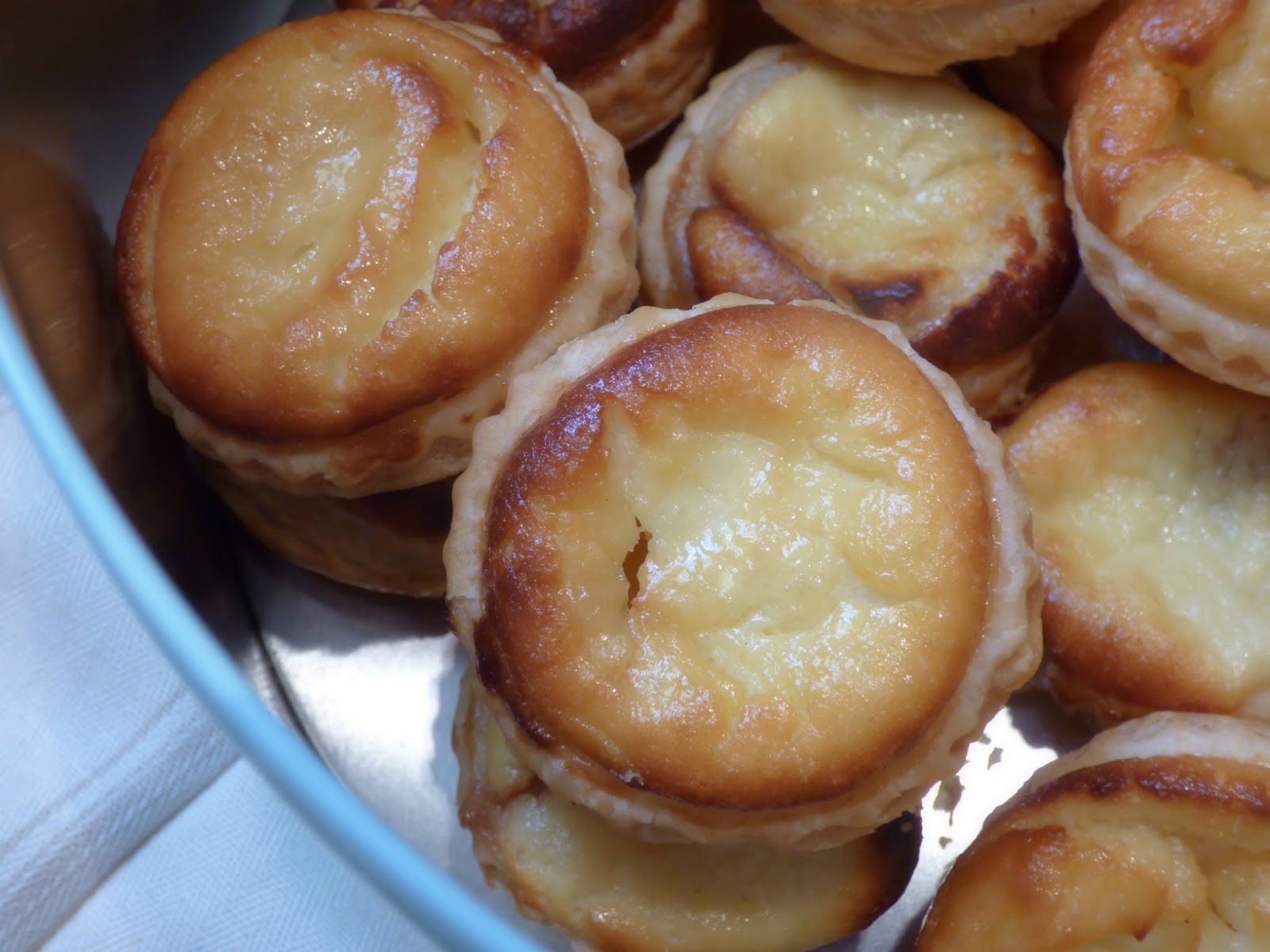
A quick google for Tudor recipes suggested baking Maids of Honour - curd cheese pastries, much appreciated by Henry VIII and Anne Boleyn. According to the legend, the king went to visit Anne Boleyn in her rooms, and saw her scoffing those pastries. He loved them so much that he confiscated the recipe and kept it in the iron box to be used only for the Royal Consumption only. That's love for you.


There are quite a few recipes around, but that's where the confusion begins.
Some use puff pastry, some use shortcrust pastry. Some bakers add a raspberry jam, the others - quince jam, then there's Delia with a lemon curd.
You can find a recipe for Maids of Honour as made by Richmond House, who claim its roots back to the original recipe. One of the ingredients they have is a mashed potato. Not quite sure about its authenticity then, as potatoes were introduced to Great Britain by Sir Francis Raleigh, so that would be already after Henry VIII.
Then there's the food historian and chef Clarissa Dickson Wright's recipe - her Maids of Honour are made with ground almonds and quince jelly, and not a spoonful of curd cheese in sight.

Having read all the available recipes thoroughly, I decided to adapt several of them.
First of all - oh horror - I used a ready-made puff pastry. Mary Berry would need her smelling salts. But, but, but... good old Delia, thanks God for Delia, uses a block of fresh puff pastry in her Richmond Maids of Honour recipe.
I didn't make my own curd either, a jar of a supermarket own lemon curd worked perfectly well.
I decided to make half a batch with lemon curd, and half - with raspberry jam.

Maids of Honour
Ingredients:
1 pack of puff pastry ready rolled (320g)
150g curd cheese
40g caster sugar
zest of 1 lemon
1 egg
1 egg yolk
20g ground almonds
2tbsp lemon curd
2tbsp raspberry jam

You will need to take the pastry out of the fridge at least 30 minutes before working with it. Unroll the pastry, and using a cookie cutter, cut out 24 mini rounds. You might need to re-roll the scraps of dough to cut out more circles.
Bake in two batches, if using a 12-piece cupcake tin.
Slightly butter the tin before putting the pastry circles inside, and slightly press in to get a cup-shape.
Add a bit of curd cheese on each pastry and spread it evenly.
In a medium mixing bowl beat together the curd cheese with sugar, egg, egg yolk and lemon zest. Add the ground almonds and mix well. Use half of the mix to fill in each pastry, about 1 heaped tsp each.
Bake in the oven preheated to 200c for about 20 minutes until golden.

Take out of the oven, let the pastries cool a bit, take out.
Then repeat with the raspberry jam for the second batch.

Don't worry about the cracked curd cheese, it only adds to their rustic appearance.

Both version were delicious, though the lemon curd variety is my favourite.
And they store beautifully in the new spacious tin.

Have you been inspired by GBBO? What did you bake/

Tudor recipes

Disclosure: I received a GBBO tin for the purposes of reviewing. All opinions are mine.


Thursday, 28 April 2016

The Tower of London 1000 piece jigsaw puzzle from Ravensburger

best jigsaw puzzles


Years ago, when I was a student in Russia, I was dreaming of visiting London and seeing all the galleries and all the places of interest which we studied in our English language lessons. Fast forward 20+ years, I have indeed visited London on numerous occasions and have explored a good amount of the city attractions but for some reason I have never visited The Tower of London. Perhaps one day I will, when Eddie's a bit older.
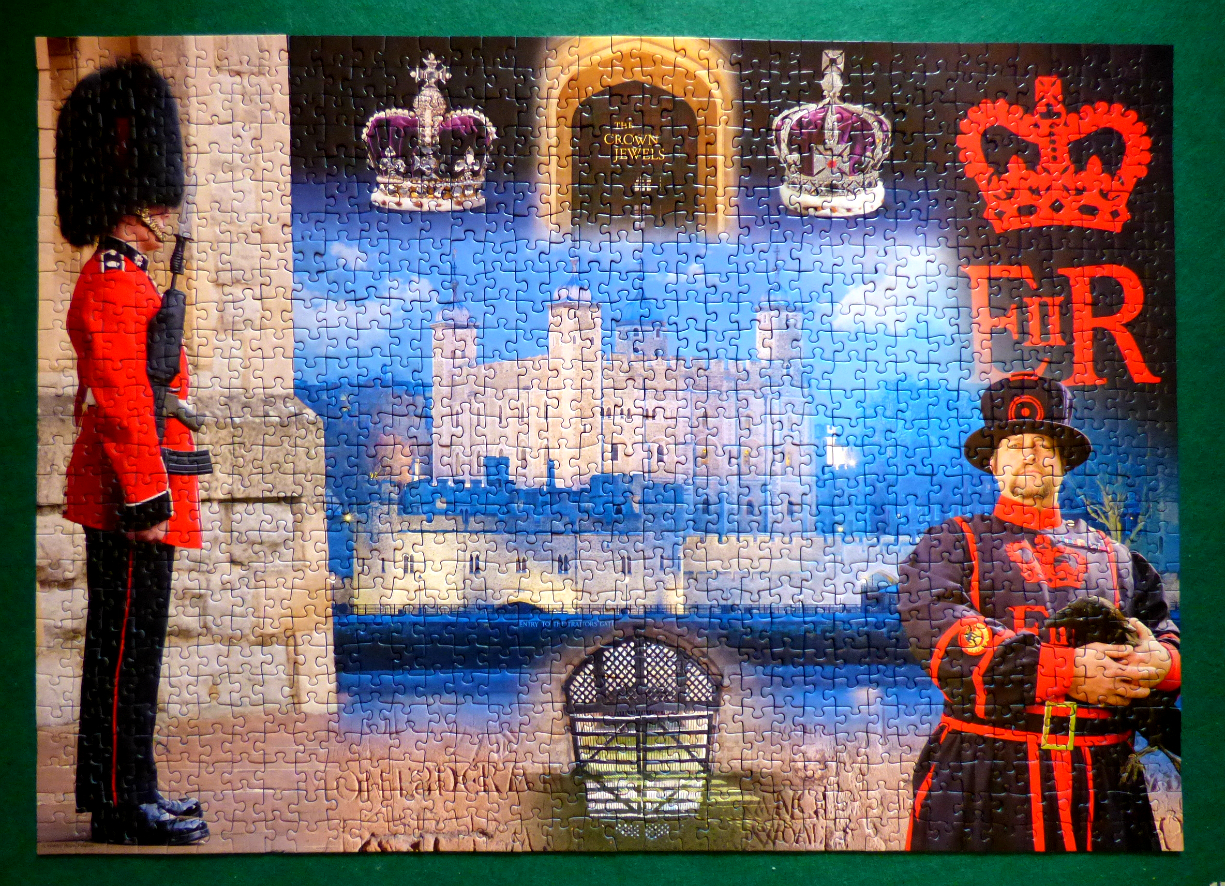
In the last week I've been enjoying a new puzzle from Ravensburger - The Tower of London 1000 piece jigsaw puzzle - which is part of the Historic Royal Palaces series.

best 1000-piece jigsaw puzzles


This splendid puzzle is suitable for ages 10+, but can be easily enjoyed by oldies like me. It was a real treat to work on this beautiful puzzle.
It features eight different photos of The Tower of London, taken from the archives of Historic Royal Palaces.
This historic landmark has been a palace for over 900 years, and is of course one of the most popular tourist destinations.


What comes to mind when you think of The Tower of London? The world famous Crown Jewels, the Beefeaters and Guardsmen on duty, and of course, its fame as a prison.
The puzzle has captured all the main attractions of the palace in one colourful collage. There is a Guardsman and a Yeoman Warder, The Traitors' Gate, one of the legendary ravens, the Crown Jewels, the graffiti carved on the stone walls by the doomed prisoners of the Tower and of course the palace itself, with the most spectacular evening view of The White Tower.


Earlier this year I have completed the Hampton Court 1000 jigsaw puzzle. The Tower of London is a fabulous addition to the series. Purchases of the puzzles from the series support the work of Historic Royal Palaces. Not only you buy a treat for someone or indeed yourself, you support a worthy cause.


Like all the Ravensburger puzzles, it has a picture sheet which you can use as a reference. The jigsaw puzzle pieces are made of sturdy cardboard.
This puzzle will make a lovely gift for any jigsaw puzzle addict like me, or a history buff.


Disclosure: I received the puzzle for the purposes of reviewing. All opinions are mine.


Sunday, 9 August 2015

Punch and Judy Show in Marriott's Walk


Every Saturday this month there is a show for children at the Marriott's Walk, Witney. We missed last week's performance, so made sure we'd be there for the Punch and Judy show.
We arrived around 12pm to find that the show has just started.
Eddie was hesitant at first to go and sit on the rug in front of the booth among the other children, but having seen that one of his class mates was there (she waved to him), he joined in.
This was the first time Eddie watched the Punch and Judy Show. This puppet show was following the classic routine, with Punch and Judy hitting each other with sticks.
This show goes back to the 17c in this country, and to even earlier times in Italy, where Punch has been named Pulcinella. Samuel Pepys described one such show in his famous diaries.


There are some pretty shocking violent scenes, when Mr Punch puts his baby in the meat grinder and turns him into a sausage.


There is a creepy looking clown, trying to use a crocodile's head as a cushion. Clowns do freak me out. There will be a clown show next Saturday. Somehow I think I'll skip that one.


Eddie was fascinated and completely absorbed in the show. He screamed with the other kids, he pointed to the puppets and prompted the show when the audience was asked to be involved.
Later, when I asked him what he liked the best, he replied "Everything, Mummy, I loved everything". It's true, he liked it so much that we watched it later in the day again, after having lunch at home. We just managed to catch the last show of the day.


Kids were screaming and laughing so loud, I saw my guy holding his ears shut for a moment.


He was glued to the show, and didn't pay any attention to me. At those moments, only the show existed for him.


Policeman Jelly Belly


It was the last show of the day, after which the carpet was folded into the car, the puppets put into boxes, but Eddie was still lingering at the square, reluctant to go back home. I could only entice him back by promising that we'd stop by our "secret place" and feed the ducks.
When we got there, two boys of about the same age as Eddie were happily splashing in the murky water.
Their father was nearby. We found out that they were also fishing, and the older boy mentioned that their Dad might catch the duck for dinner. I don't know if he was pulling Eddie's leg, or if they were truly intending to eat the duck (I hope not). From their friendly chatter, I realised they were travellers.
Eddie easily makes friends, and wanted to stay and play with the boys, but we had to go. On the way home, I explained to Eddie who the travellers were, and he told me "I wish we lived like that", bless him. He also wanted to invite them to our house.
This morning he wanted to go back to check on the duck.


Country Kids from Coombe Mill Family Farm Holidays Cornwall

Monday, 31 March 2014

Seville & blood orange marmalade

There is a plethora of jams, jellies and marmalades popular in Russia which are virtually unknown in the UK. Yet the Seville orange marmalade which seems to be so quintessentially British is not well known in my homeland. I tried it for the first time about 18 years ago, when I arrived to Canterbury as a British Council student. It must have been a humble supermarket fodder, and I wasn't much impressed. Since then, I have discovered some marvellous jam-making brands and have also learnt how to make my own Seville orange marmalade.
The story goes that the Seville orange marmalade was invented in the early 18C, when a Spanish ship with a cargo of Seville oranges found refuge in Dundee. The oranges were snapped for pennies by the local merchant James Keiller, and his wife turned them into a novelty preserve.

There are many recipe for Seville orange marmalade online, the one that I used as my source of reference is the ultimate Seville orange marmalade by BBC Good Food. I have adapted it and used a mix of Seville and blood oranges, plus added some whisky.


Seville & Blood Orange Marmalade
Ingredients:
800g Seville oranges
500g blood oranges
1 lemon (juice)
1kg preserving sugar
1.6kg granulated sugar
3tbsp whisky

Take a cooking pan big enough to take in all the oranges, pour about 2 litres of water to cover the fruit as well as the lemon juice. Bring to boil, then lower the heat and simmer on low for 2 hours. At this point the peel will be easily pierced with a knife or fork. Once cooled to tepid, take the oranges out and let them drip via a colander over the pan to get all the juices.
Cut the oranges in half. Scoop the insides, pips and all (that gives a high pectin content to your preserve), add them to the pan with the water where the oranges were cooked. Bring the liquid to boil and cook for about 10 minutes. Then strain the liquid through a sieve, and using a wooden spoon, squash the orange bits through. Discard the remaining pips and pith.


Cut the peel with a sharp knife into strips of your preferable thickness, fine or wide. Add the sugar, both granulated and preserving to the pan of orange liquid and bring to boil, until all the sugar is dissolved. Add the shredded peel. Bring to boil again and bubble rapidly for 20-25 minutes until the setting point is reached.
Add the whisky if using. You might want to add a little blob of butter to get rid of the scum, stir it in gently. Let the marmalade cool a little (maybe 10 minutes), then pour it with a ladle into sterilised jam jars. Seal them while still hot.
If you don't have blood oranges, just use the Seville oranges, but the combination of two types of oranges makes it more exciting and the colour is beautiful.


Chris from Cooking Around the World has invited the bloggers to submit a recipe which represents Great Britain, and though I'm fashionably late, this is my entry for this linky.